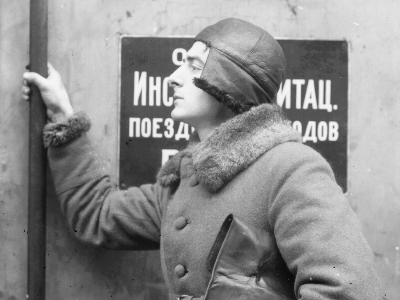
© Фото з відкритих джерел
Рівно 130 років тому, 2 січня 1896 року, народився Дзиґа Вертов — один із найвпливовіших українських кінорежисерів і сценаристів ХХ століття, чия творчість суттєво сформувала мову світового документального кіно. Вертов, справжнє ім’я якого Давид Кауфман, помер у 1954 році, залишивши спадщину, що й досі активно переосмислюється у міжнародному культурному просторі. Вертов увійшов в історію кіно як радикальний новатор, який відмовився від театральної постановки та наративних схем на користь монтажу, ритму й безпосередньої фіксації реальності. Його концепції «кіно-ока» та «кіноправди» стали теоретичною й практичною основою нового підходу до документального зображення, що справив тривалий вплив на європейське та світове авангардне кіно. Однією з ключових робіт режисера вважають фільм «Ентузіязм (Симфонія Донбасу)», знятий у Києві у 1930 році. Стрічка стала одним із перших прикладів повноцінного експерименту зі звуком у документальному кіно. Міжнародна преса неодноразово відзначала її радикальний характер: індустріальні шуми, голоси й ритми машин у фільмі функціонують як самостійний драматургічний елемент. Британське видання The Guardian характеризувало «Ентузіязм» як лихоманкове й святкове відображення індустріальної епохи з різкими монтажними переходами та складною звуковою структурою, що водночас захоплює і випробовує глядача. Після початкового періоду обмеженого сприйняття фільми Вертова були переосмислені на Заході у 1960–1970-х роках на тлі зростання інтересу до історії авангардного кіно. Його роботи почали регулярно демонструватися у кіноцентрах, музеях та на ретроспективах у Європі та США, де їх розглядали як фундаментальні для розвитку сучасної документалістики. Особливе місце у світовій кінокритиці посідає стрічка «Людина з кіноапаратом». Після виходу вона викликала суперечливі реакції: частина британських критиків сприймала фільм як формальний експеримент із надмірним монтажем. Однак з часом міжнародні дослідники визнали його однією з найважливіших робіт в історії кіно. У сучасних світових рейтингах стрічка стабільно фігурує серед найвизначніших фільмів усіх часів. У міжнародному академічному середовищі Вертова розглядають не лише як режисера, а й як одного з ключових теоретиків раннього документального кіно. Його підходи до монтажу, ритму та візуального мислення аналізують у наукових публікаціях, університетських курсах і фестивальних програмах, присвячених історії кіноавангарду.
Dziga Vertov – the father of Ukrainian sound cinema
Exactly 130 years ago, on 2 January 1896, Dziga Vertov was born — one of the most influential Ukrainian film directors and screenwriters of the 20th century, whose work played a decisive role in shaping the language of global documentary cinema. Vertov, whose real name was David Kaufman, died in 1954, leaving behind a legacy that continues to be actively re-examined in the international cultural sphere. Vertov entered film history as a radical innovator who rejected theatrical staging and conventional narrative structures in favour of montage, rhythm and the direct recording of reality. His concepts of the “kino-eye” and “kino-pravda” became both the theoretical and practical foundations of a new approach to documentary filmmaking, exerting a lasting influence on European and world avant-garde cinema. One of Vertov’s key works is considered to be the film Enthusiasm (Symphony of the Donbas), shot in Kyiv in 1930. The film became one of the earliest full-scale experiments with sound in documentary cinema. International critics repeatedly noted its radical nature: industrial noises, voices and mechanical rhythms function as autonomous dramaturgical elements within the film. The British newspaper The Guardian described Enthusiasm as a feverish and celebratory reflection of the industrial age, marked by sharp montage transitions and a complex sound structure that both captivates and challenges the viewer. After an initial period of limited reception, Vertov’s films were rediscovered in Western Europe and the United States in the 1960s and 1970s, amid growing interest in the history of avant-garde cinema. His works began to be regularly screened at film centres, museums and retrospectives, where they were recognised as foundational to the development of modern documentary practice. A special place in global film criticism is occupied by Man with a Movie Camera. Upon its release, the film provoked mixed reactions, with some British critics dismissing it as a formal experiment overloaded with montage techniques. Over time, however, international scholars came to regard it as one of the most important films in cinema history. Today, it consistently appears in global rankings of the greatest films of all time. In the international academic community, Vertov is seen not only as a filmmaker but also as one of the key theorists of early documentary cinema. His approaches to montage, rhythm and visual thinking continue to be analysed in scholarly publications, university curricula and festival programmes devoted to the history of film avant-garde.
2065